I’m grateful to be recognised by Design Business Chamber Singapore as a 2026 Seed Award winner, and to Prof Lay Kee (Ricky) Ang and Dr Sumbul Khan for putting my name forward and supporting the nomination.
BOLD’s EdTechnical episode ‘Why chatbots aren’t the future of educational AI’ has selected my AIED 2026 paper on ES-LLMs as further reading—an encouraging sign that interpretable pedagogical orchestration is entering the wider conversation.
A new SSRN technical report introduces Critsly, an artefact-aware AI critique workspace, and StudioCrit, its architecture-studio research mode. The report documents simulation-based readiness evidence, clearly defines its present limitations, and opens the door to research and application collaborations.
At SISTC 2026, I will present our study of how science teachers translate misconceptions, learner interactions, evidence, authority, and safeguards into specifications for agentic learning apps.
On 16 September 2026, I will speak at SUTD’s SMT Teaching Exchange about using AI to adapt teaching materials for diverse learners. The talk uses Clio as a practical case study while keeping human oversight at the centre.

 I’m grateful to be recognised by Design Business Chamber Singapore as a 2026 Seed Award winner, and to Prof Lay Kee (Ricky) Ang and Dr Sumbul Khan for putting my name forward and supporting the nomination.
 BOLD’s EdTechnical episode ‘Why chatbots aren’t the future of educational AI’ has selected my AIED 2026 paper on ES-LLMs as further reading—an encouraging sign that interpretable pedagogical orchestration is entering the wider conversation.
 A new SSRN technical report introduces Critsly, an artefact-aware AI critique workspace, and StudioCrit, its architecture-studio research mode. The report documents simulation-based readiness evidence, clearly defines its present limitations, and opens the door to research and application collaborations.
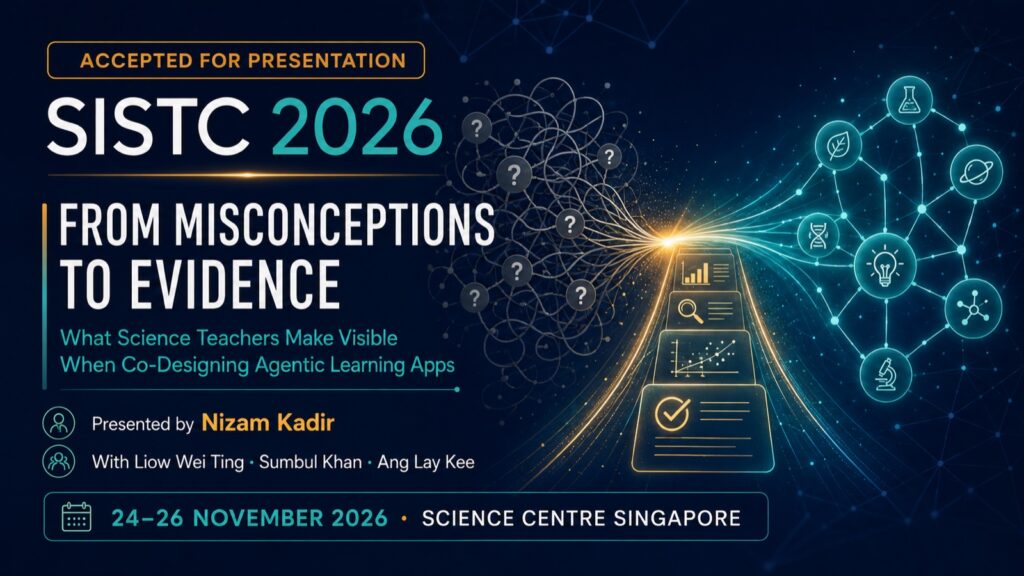 At SISTC 2026, I will present our study of how science teachers translate misconceptions, learner interactions, evidence, authority, and safeguards into specifications for agentic learning apps.
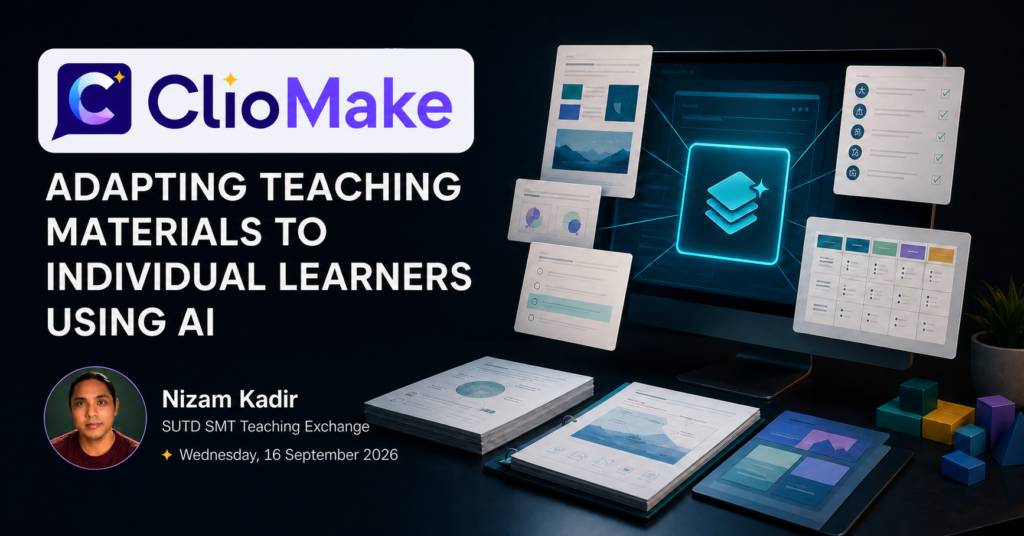 On 16 September 2026, I will speak at SUTD’s SMT Teaching Exchange about using AI to adapt teaching materials for diverse learners. The talk uses Clio as a practical case study while keeping human oversight at the centre.